Linear alternative
Takahe vs Linear: AI agents in both, time and money in one.
Linear is a product development system for software teams and their agents, planned in cycles, projects and initiatives. Takahe is made for teams that bill their time: tasks on a board, a timer on every task and profit per project. Both let AI agents work as teammates.
Already have an account? Log in
Which one fits you?
Choose Takahe if
- You need to know how many hours went into a task, a project or a client.
- You bill your time and want rates, budgets and profit next to the tasks.
- You work for clients and want each one in its own team.
- Your AI agents should track the time they spend, next to people’s.
Choose Linear if
- You build a software product and plan it in cycles, projects and initiatives.
- You want issues tied to pull requests and code in GitHub or GitLab.
- You collect requests from Slack and e-mail and triage incoming issues.
- You want native apps for Mac, Windows, iOS and Android.
Feature by feature
Takahe vs Linear, side by side
What each tool offers on its own, without add-ons from a marketplace. Checked on November 22, 2026 on Linear’s own pages, listed below.
| Feature | Takahe | Linear |
|---|---|---|
| Views | Takahe Yes. Board, list and calendar of the same tasks. | Linear Yes. List and board views of issues, and timelines of projects. |
| Time tracking | Takahe Yes. A timer on every task and manual entries, with notes, tags and a billable flag. | Linear No. No time tracking. Estimates are complexity points, and integrations such as Harvest add a timer. |
| Timesheets and time reports | Takahe Yes. A Time page per project and reports by project, list, person or task, with CSV export. | Linear No. No timesheets or time reports. |
| Rates, cost and profit | Takahe Yes. A cost rate and a bill rate per person and project. Reports show cost, revenue and profit. | Linear No. No rates, cost or profit. |
| Project budgets | Takahe Yes. A budget in hours, in euros or both, with alerts at 80% and 100%. | Linear No. No project budgets. |
| AI agents over MCP | Takahe Yes. A built-in MCP server. An agent works on a project under its own name and tracks its own time. | Linear Yes. An MCP server and AI agents you assign issues to, on every plan. |
| Clients and guests | Takahe Yes. Invite clients to a team or to one project. As members, they never see rates or profit. | Linear Partly. Guests on the Business and Enterprise plans, billed as regular members. |
| Sprints and roadmaps | Takahe No. No sprints, story points, roadmaps or Gantt charts. | Linear Yes. Cycles, projects, initiatives and releases. |
| Custom fields and automations | Takahe Partly. Lists as stages, tags, priorities and estimates. No custom fields or automation rules. | Linear Yes. Custom statuses, labels, templates, triage and issue SLAs. |
| Integrations | Takahe Partly. Webhooks, an MCP server and a Chrome extension. No integrations marketplace. | Linear Yes. GitHub, GitLab, Slack, Figma and many more. |
| Mobile | Takahe Partly. Made for the phone’s browser and installs to the home screen. No app in the app stores. | Linear Yes. Apps for iOS and Android, and for Mac and Windows. |
| Self-hosting | Takahe No. Cloud only. | Linear No. Cloud only, hosted in the US or the EU. |
| Sign-in and SSO | Takahe Partly. Passkeys and two-factor authentication. No SAML single sign-on. | Linear Yes. SAML and SCIM on the Enterprise plan. |
A timer on every task
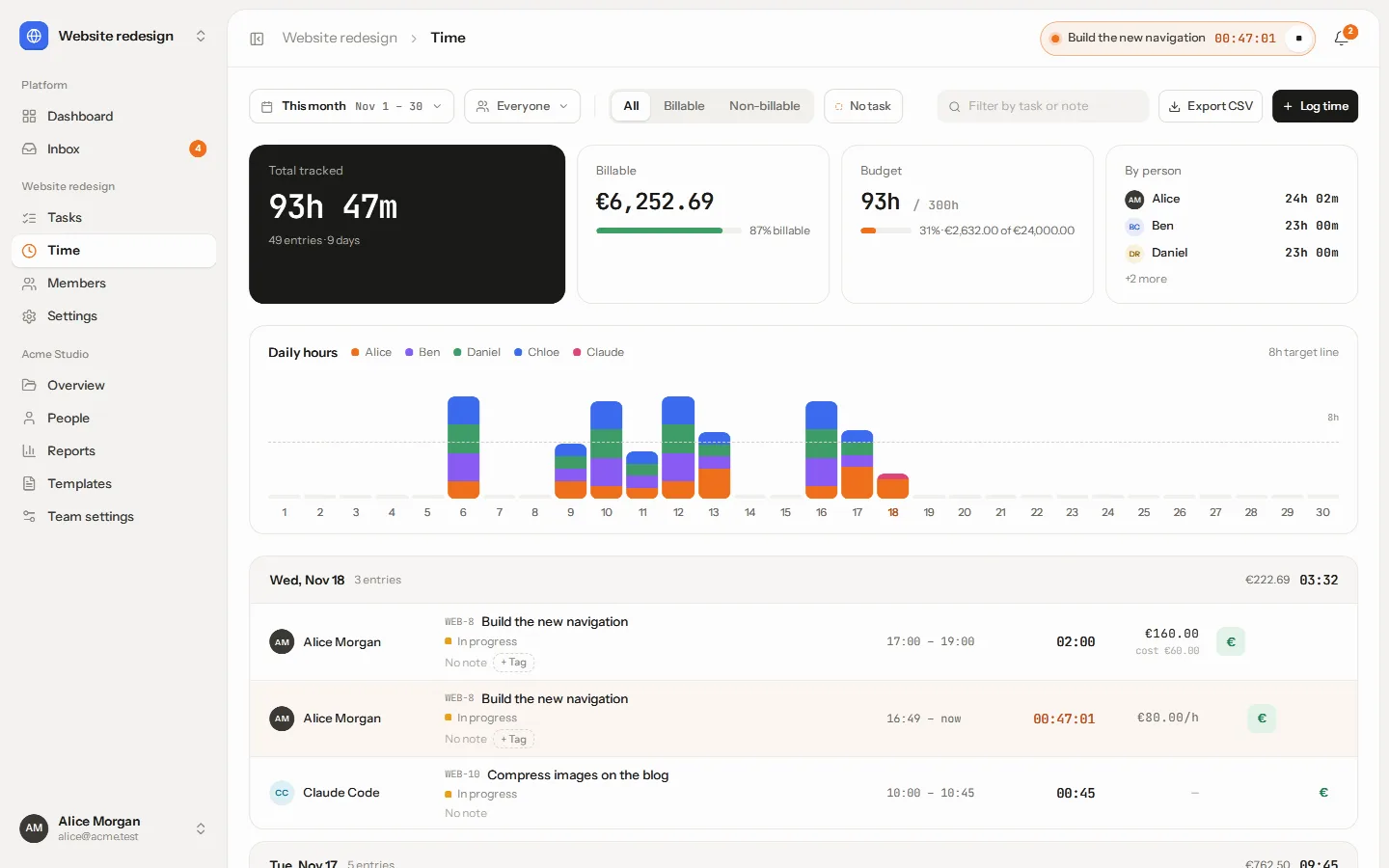
Linear has no time tracking of its own: estimates are points, and hours come from an integration. In Takahe, every task has a play button, and every project has a Time page with hours per person and per day.
- One click on a card starts the timer, which stays in the top bar on every page
- Log forgotten time afterwards with a start and an end, or a duration such as 1:30
- Each project’s Time page sums up its hours, people and days, with CSV export
See whether a project pays
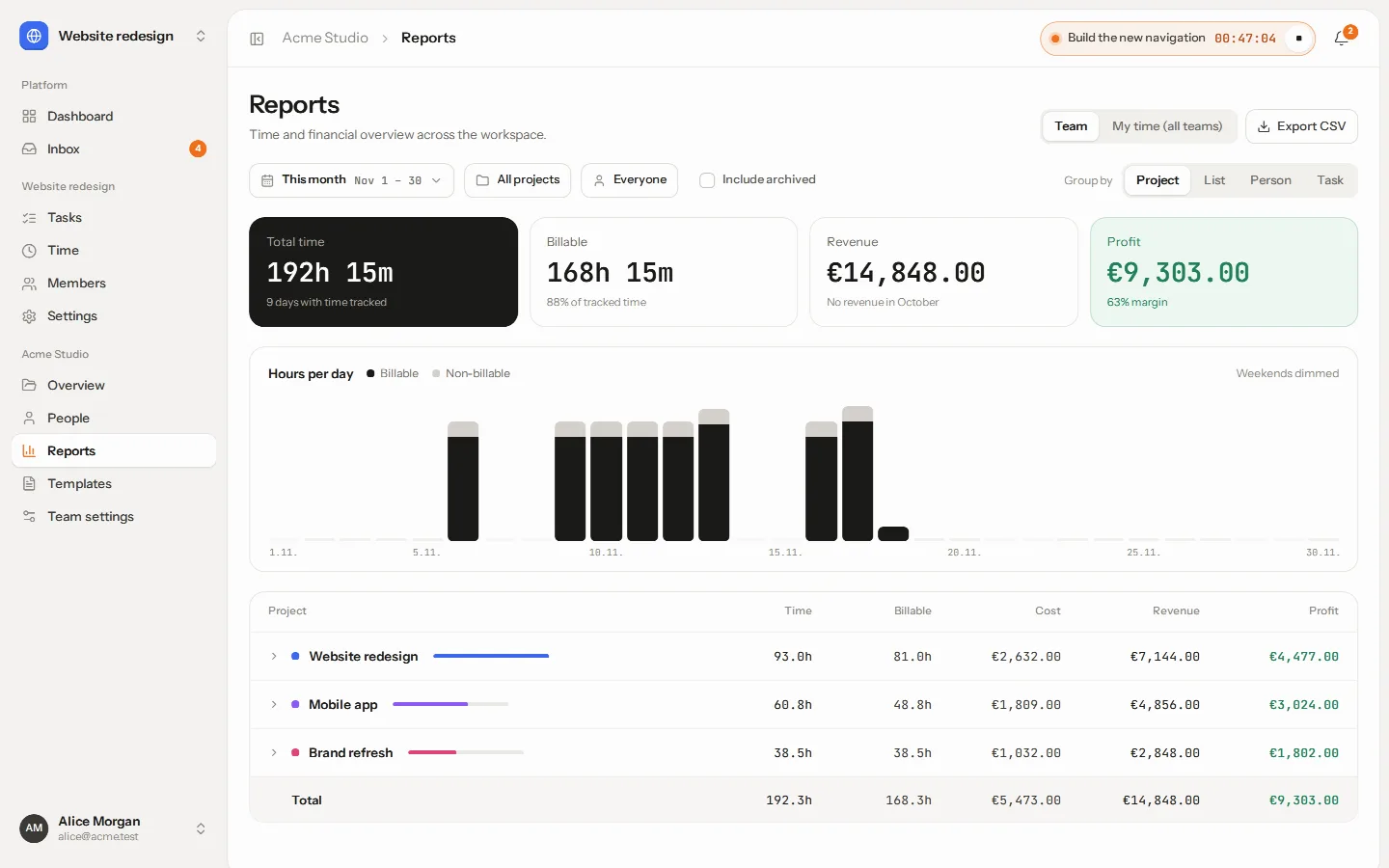
Rates turn the tracked time into cost and revenue, and budgets warn you before a project runs over. You see whether a client pays off, not just what shipped.
- A cost rate and a bill rate per person, set for the team and adjusted per project
- Budgets in hours or euros, with alerts at 80% and 100%
- Only the people who manage a project see the money
AI agents that track their own time
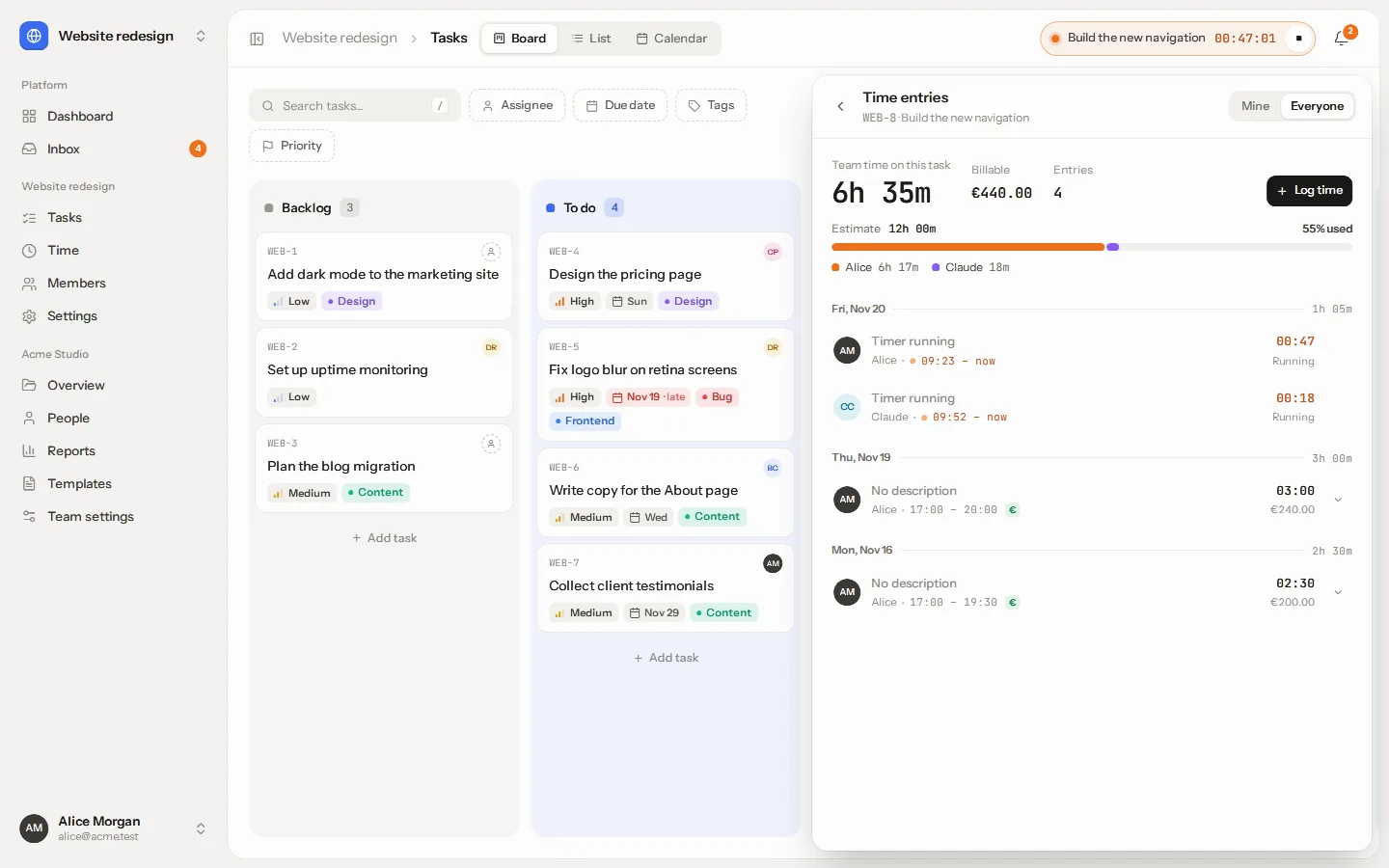
Both tools let an AI agent take on work. In Takahe, the agent also starts and stops its own timer, one per task, so you see what AI spent on a project next to people’s time.
- A project token gives the agent its own name, marked “mcp”, on one project
- It reads tasks and files, comments, creates subtasks and moves cards
- It never sees rates or profit and can’t sign in to the web app
A team for every client
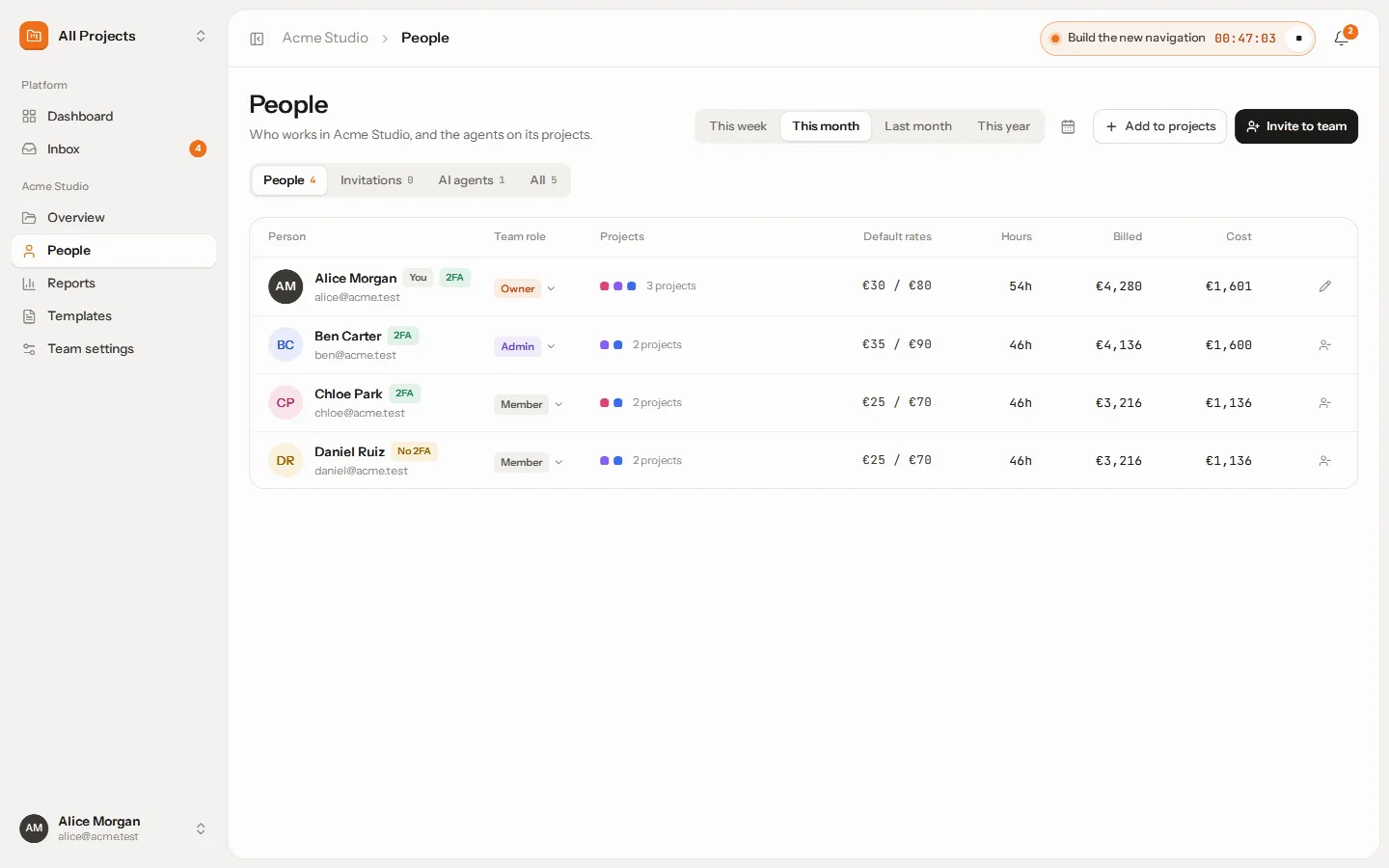
Takahe keeps each client in its own team, with its own projects, people and rates. Invite a client to their project, and they see the work but not your money.
- People and projects in one team never see another team’s work
- Invite a client to the team or straight to one project
- Members see their own time and earnings, never your rates
FAQ
Questions, answered
Is Takahe a good Linear alternative?
If you work for clients or bill your time, yes: Takahe puts time tracking, rates, budgets and profit next to tasks on a board. If you build one software product in cycles and initiatives, Linear fits better.
Does Linear have time tracking?
No. Linear estimates issues in complexity points, and time tracking comes from integrations such as Harvest or Everhour. Takahe has a timer on every task, manual entries and time reports.
Can AI agents work in Takahe like in Linear?
Yes. Takahe has a built-in MCP server. With a project token, an agent such as Claude Code works under its own name, comments, moves tasks and tracks its own time.
Can I move my work from Linear to Takahe?
There is no Linear import. Paste a list of task titles into a Takahe list and each line becomes a task, or start from a project template. An AI agent connected to both tools over MCP can also copy your open work for you.
How we compared
We checked what this page says about Linear on November 22, 2026, on these pages from Linear. Plans and features change, so look there for the latest.
- Linear pricing and plans
- Issue properties and estimates
- Harvest integration
- Linear MCP server
- Agents in Linear
- Members and roles
- Security and data hosting
Linear is a trademark of Linear Orbit, Inc. Takahe isn’t affiliated with or endorsed by Linear.
Try Takahe on a real project.
Create your account, set up a project and track your first hour in a few minutes. Keep Linear open next to it and compare for yourself.
Already have an account? Log in